
Indian Handloom Cotton: What NRIs Should Know Before Buying
Published on 23rd September 2026 by Vismaya R K
Shopping
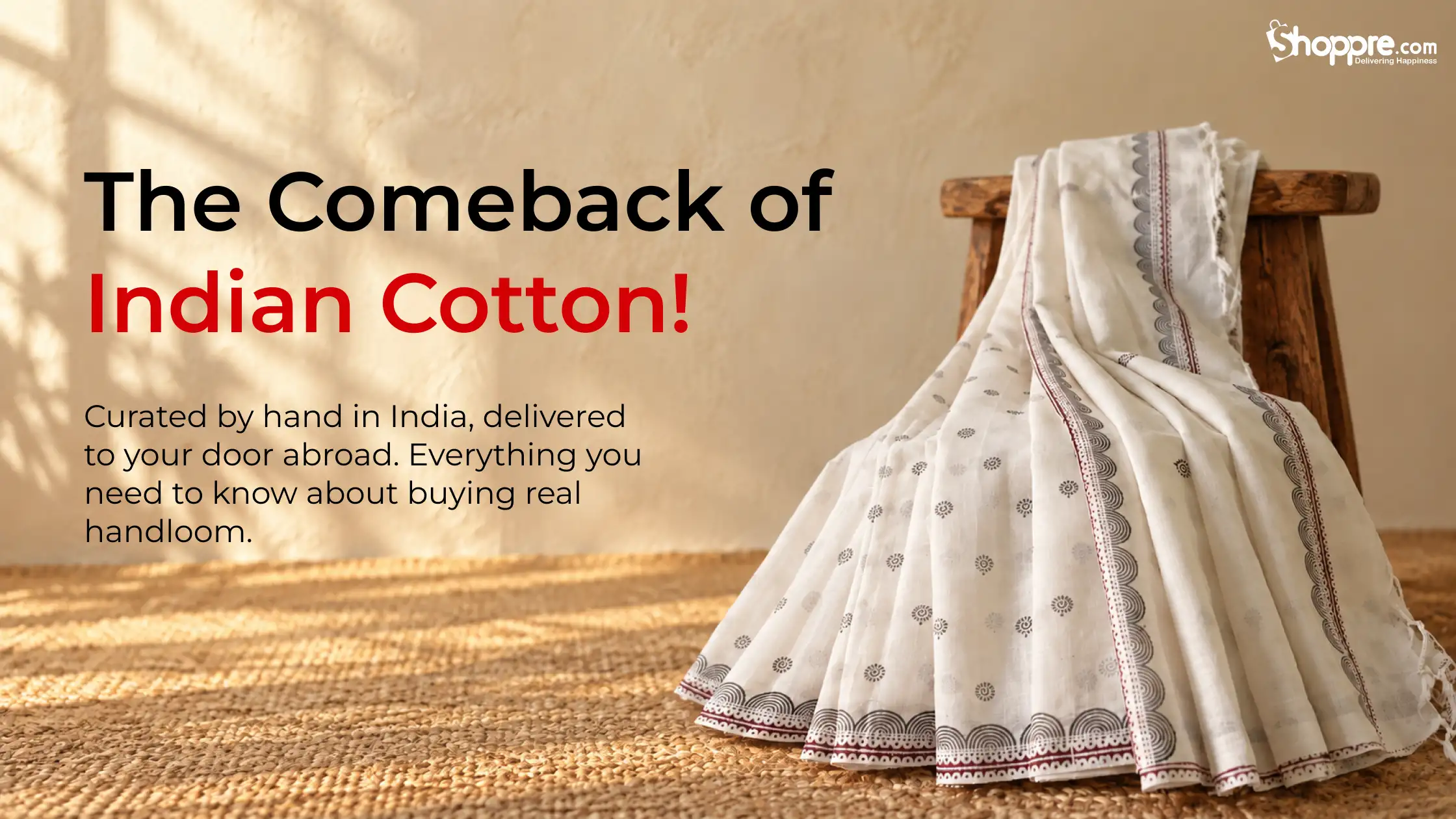
Indian handloom cotton is worth considering if you want sarees, kurtas and fabrics you can wear beyond special occasions. But buying well means checking more than the textile’s name: confirm its fibre composition, how it was made, who is selling it and how it should be cared for.
For NRIs, the next step is arranging the purchase and delivery. Some sellers accept overseas orders directly. Where they do not, parcel forwarding can help with eligible purchases, while a personal shopping service may help when you cannot complete the order yourself.
Why choose a handloom for your everyday wardrobe?
A cotton kurta can work with trousers you already own. A lightweight dupatta can add colour without requiring a complete festive outfit. A saree chosen for its comfort and manageable care needs may get more use than something bought for one event.
That is a practical reason to explore handloom, not a promise that every handwoven garment will last longer than every machine-made or synthetic alternative.
Durability depends on the yarn, fabric construction, finishing, stitching and care. A delicate weave still needs careful handling, however skilfully it was made.
Start with what you will actually wear:
For regular use, consider opacity, fit and washing requirements.
For warm weather, compare fabric weight and lining.
For celebrations, check whether fine weaves, silk or zari require specialist care.
For tailoring, confirm the fabric’s width, usable length and shrinkage guidance.
Handloom, cotton and block printing mean different things
These terms describe different parts of a textile:
Term | What it describes | What it does not prove |
Cotton | Fibre content | That the fabric was handwoven |
Handloom | The weaving method | That the fabric is pure cotton |
Hand-block printed | How a pattern was applied | That the underlying cloth is handloom |
Natural-dyed | A claim about the dyes used | That the cloth is handwoven or colourfast |
A printed cotton kurta can be appealing without being handloom. The important thing is that the description matches what you are paying for.
The government handicrafts directory identifies Bagru and Kutch Ajrakh as hand-block-printing traditions. Ask separately about the base fabric and weaving method.
Indian textiles worth exploring
Use these names as starting points for questions, not substitutes for product details.
Textile | What to explore | What to confirm |
Chanderi | Lightweight sarees and dress materials | Cotton, silk or a blend; transparency and care |
Bengal tant | Cotton sarees for regular wear | Fibre content, finish and washing instructions |
Kota Doria | Airy, checked sarees and dupattas | Fibre blend, sheerness and snag sensitivity |
Jamdani | Textiles with woven decorative motifs | Weaving method, fibre and place of production |
Mangalagiri | Sarees and fabrics for stitched clothing | Composition, fabric width and border details |
Ajrakh and Bagru | Block-printed clothing and fabric | Base cloth, printing method and dye information |
Chanderi is not automatically pure cotton
Chanderi includes cotton-and-silk textiles, so a listing labelled simply “Chanderi” does not establish its fibre composition. Ask for the composition in writing, especially if you specifically want cotton. Incredible India’s Chanderi guide describes the cotton-silk weaving tradition.
Kota Doria can contain silk
Kota Doria is associated with a lightweight checked structure. The National Portal of India describes it as a cotton-and-silk fabric. Do not assume that a Kota Doria purchase should be washed like an ordinary cotton shirt.
A regional name is only part of the story
Ask where the item was woven or printed and whether the seller can identify the producer, workshop or cooperative.
A clear answer is useful evidence. A familiar textile name, village photograph or social-media video alone does not authenticate the specific item being sold.
How to assess a handloom listing from abroad
Look beyond irregularities
Small variations may occur in handmade textiles, but irregularity alone is not proof of handloom. Equally, neat and consistent work is not evidence that a textile was machine-made.
Request close-up photographs of the weave, borders and reverse side. Use them alongside information about the maker and any supporting labels.
Ask about Handloom Mark
India’s Handloom Mark scheme is intended to help identify genuine handwoven products. If a seller claims certification, ask for the label details and verify them through the scheme’s official channels. Government guidance identifies Handloom Mark as an authenticity measure. Development Commissioner for Handlooms
The absence of a label does not, by itself, prove that a piece is machine-made. It means you need other credible evidence.
Treat price as a question, not a verdict
A surprisingly low price is a reason to ask about fibre, technique, dimensions and condition. It is not enough to authenticate or reject an item.
Likewise, a high price does not establish quality. Compare similar products with similar materials and workmanship.
Ask what a GI claim refers to
If a listing mentions a Geographical Indication, request the exact registered name and information connecting the product to that origin. A GI claim should not be treated as interchangeable with fibre certification or proof of a particular seller’s reliability.
A checklist to send the seller before paying
Copy these questions into your enquiry:
Composition: What fibres are used, and in what proportions?
Method: Is the cloth handwoven, machine-woven or only hand-printed?
Origin: Where was this particular piece made?
Evidence: Can you share maker details, relevant labels and close-up photographs?
Measurements: What are the exact dimensions or garment measurements?
Contents: Does the price include blouse fabric, lining, stitching or other pieces?
Care: What washing method is recommended? Is shrinkage or colour transfer expected?
Availability: Is this exact piece ready to dispatch or made to order?
Returns: What happens if it arrives damaged or differs from the description?
Delivery: Where can you ship, and which payment methods do you accept?
Keep the replies, invoice and product photographs with your order record.
If a seller cannot clarify a detail that matters to you, such as pure cotton content or handwoven construction, pause before purchasing.
How to buy Indian handloom while living abroad
The right route depends on what the seller can already offer.
Buy directly when the seller supports your destination
Check international delivery, accepted payments, total charges and return terms first. Direct ordering may be the simplest option when those arrangements suit you.
Do not assume every independent seller lacks international checkout.
Use an Indian address when you can place the order yourself
If a seller delivers within India but not to your overseas address, you can ask Shoppre about forwarding the eligible purchase.
Use the exact Indian address assigned to your account, including any identifying details. Confirm that the order can be received and forwarded before paying the seller.
Ask about Personal Shopper when checkout is the obstacle
For an Instagram seller, WhatsApp business or website you cannot purchase from directly, share the seller and product details through Shoppre Personal Shopper platform.
Ask whether the team can assist with that seller and confirm charges and ordering requirements. Purchasing assistance is not a guarantee of textile authenticity.
If payment is the main obstacle, read our guide tobuying from Indian websites without an Indian card.
Shoppre explains its personal shopping and forwarding services in its service FAQs.
Buying from several sellers? Compare the shipping options
You might choose a saree from one seller and unstitched fabric from another. If both purchases are going to the same overseas address, ask whether consolidation is suitable.
Combining packages may reduce unnecessary packaging or shipping costs, but savings depend on the final parcel’s weight, dimensions and applicable charges.
Also consider timing. Holding a ready-to-ship piece while another is being made can delay delivery and use up the first seller’s return window.
Before dispatch, clarify which checks are available. Warehouse photographs cannot replace an expert textile assessment or a fitting.
Care and timing belong in the buying decision
Follow the instructions for the specific piece rather than a universal “handloom wash” routine.
Pure cotton, silk blends, zari, prints and different dyes may need different treatment. If home washing is permitted, ask about detergent, soaking, drying and ironing. Do not assume that hot washing or tumble drying is suitable.
For unstitched fabric, ask whether it should be prewashed before tailoring and how much shrinkage allowance is needed.
Confirm the seller’s dispatch date separately from the international shipping estimate. Made-to-order production, domestic delivery, warehouse preparation and customs processing all form part of the journey.
Frequently asked questions
Does handloom cotton always last longer than synthetic clothing?
No. The weaving method alone does not determine lifespan. Yarn quality, construction, use and care all matter. Choose the fabric for its suitability rather than a blanket durability claim.
Can I buy from an Indian Instagram weaver while living abroad?
Possibly. Ask the seller about payment and international delivery first. If either is unavailable, check whether Shoppre can assist with the purchase or forward an eligible order.
Is Ajrakh or Bagru always handloom?
No. These names refer to printing traditions. Ask whether the underlying fabric was handwoven and what fibres it contains.
Which cotton textile should I choose for hot weather?
Compare the actual fabric’s weight, openness, lining and fit. Regional names alone do not tell you how a finished garment will feel. If pure cotton matters, confirm the composition rather than assuming it.
Choose the piece you will reach for again
Start with one saree, kurta or length of fabric that fits your routine. Get clear answers about its construction and care, then work out the purchase and delivery arrangements.
If you have found a piece but cannot complete the order, ask Shoppre Personal Shopper team about purchasing assistance. Share the product details and seller information before committing.