Shoppre Personal Shopper vs Self-Shopping: Which One Should You Use?
Published on 16th April 2026 by Vismaya R K
General
You've found the perfect kurta on Myntra. Or you need your mother's favourite brand of pickle shipped from India. Or maybe you want to buy silver jewellery from a local store in Jaipur for your sister's wedding abroad. Whatever the reason you're here is because you want to shop from India and ship internationally, and Shoppre gives you two ways to do it.
The problem? Most people aren't sure which one to pick. And choosing wrong doesn't just cost extra money it costs time, creates confusion, and sometimes means your order never happens at all.
This guide makes the decision simple. By the end, you'll know exactly which option fits your situation and when to switch between them.
The Two Ways to Shop from India with Shoppre
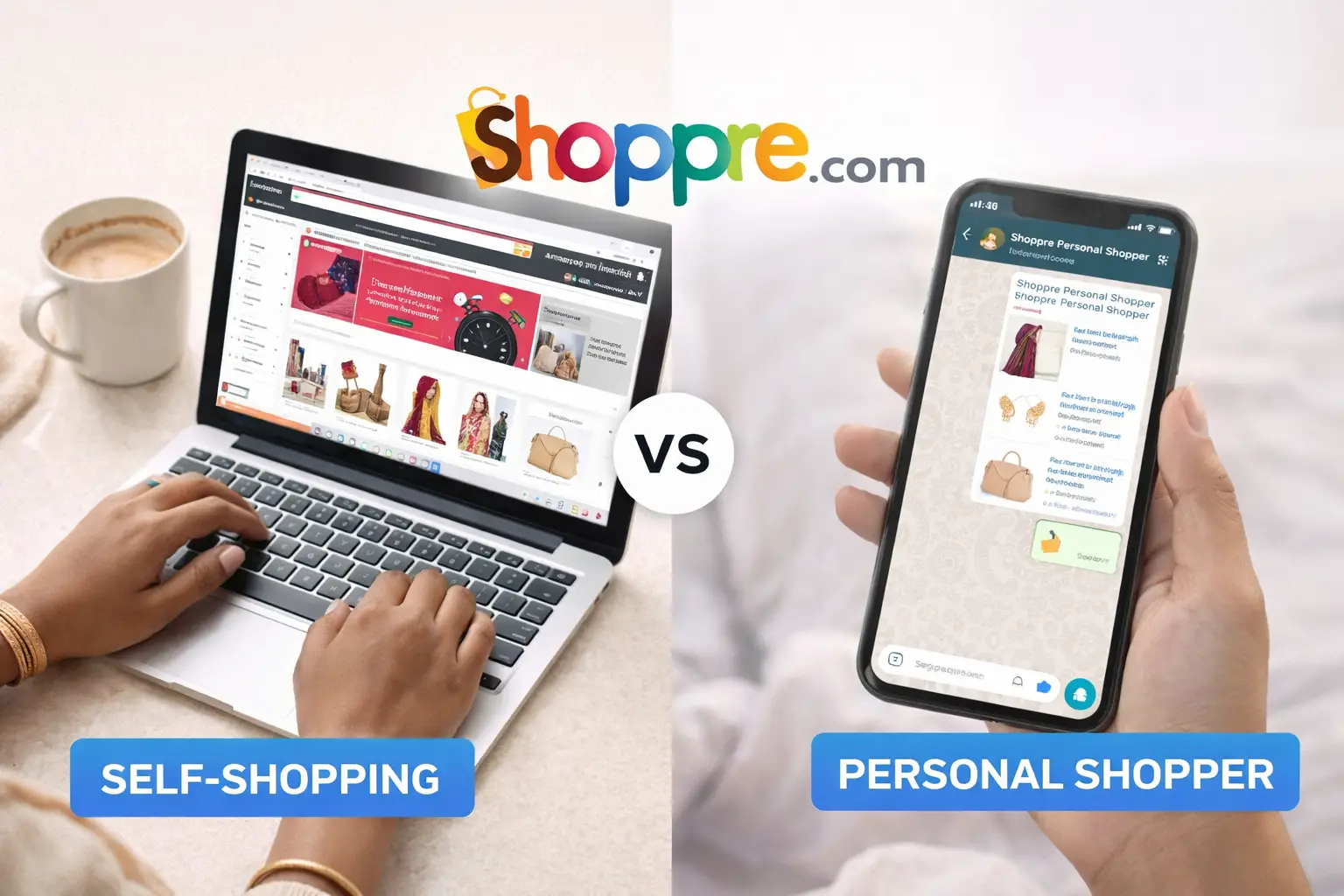
Think of it like booking a flight versus hiring a travel agent. Both get you to the same destination with your favourite Indian products delivered to your doorstep abroad. The difference is how much you want to handle yourself.
Option 1: Self-Shopping (You Shop, Shoppre Ships)
This is the hands-on approach. You do the browsing, the selecting, the ordering, and the paying. Shoppre enters the picture only after the Indian store dispatches your package.
How Self-Shopping Works — Step by Step
Step 1: Sign up on Shoppre and get your free Indian virtual address (a real warehouse address in Bangalore).
Step 2: Go to any Indian online store — Amazon, Flipkart, Myntra, Ajio, Nykaa, Meesho, or any other. Shop the way you normally would.
Step 3: At checkout, enter your Shoppre virtual address as the delivery address. Complete the payment with your card.
Step 4: The store ships to Shoppre's warehouse. Shoppre notifies you when the package arrives and adds it to your personal locker.
Step 5: Once all your orders have arrived (you get 20 days of free storage), you raise a "Ship Request." Shoppre consolidates everything into one box and ships it internationally.
Step 6: Your package arrives at your doorstep in 3–6 business days.
When Self-Shopping Is the Right Choice
Self-Shopping works perfectly when all of these are true:
You have a payment method that Indian websites accept an Indian debit/credit card, UPI, net banking, or in some cases an international Visa/Mastercard that the specific store allows.
You're comfortable navigating Indian e-commerce sites, finding the product, reading reviews, selecting the right size, applying coupons, and completing checkout without getting stuck.
You know exactly what you want, you have the product link, you've checked the price, and you're ready to buy. No browsing needed, no "can you help me find this?" questions.
The store ships within India most major sites like Amazon.in, Flipkart, Myntra, Ajio, and Nykaa deliver to any Indian address including Shoppre warehouse. If the store delivers domestically, Self-Shopping works.
The Advantages of Self-Shopping
Full control. You pick the exact variant, colour, size, and seller. Nobody makes the choice for you.
Speed. There's no middleman. You order, the store ships, Shoppre receives. The process is faster by 1–2 days compared to Personal Shopper because there's no purchase queue.
Lower cost. You pay the product price + shipping to Shoppre warehouse (usually free on most Indian sites) + Shoppre international shipping fee. No additional service charge for the purchase itself.
Better for deals and flash sales. When Amazon runs a Lightning Deal or Myntra drops a 70% off sale, you need to act fast. Self-Shopping lets you grab the deal the moment it goes live — there's no wait for someone else to process your request.
Where Self-Shopping Falls Short
The payment wall. This is the big one. Many Indian e-commerce sites reject international Visa and Mastercard. Some require Indian UPI or net banking. If your card gets declined at checkout, Self-Shopping stops working.
Account verification issues. Some Indian sites require an Indian phone number to create an account, verify OTPs, or complete checkout. If you don't have one, you're stuck.
No access to offline or local stores. That handloom saree from a weaver in Varanasi? The silver anklets from a family jeweller in Jaipur? The homemade murukku from your aunt's kitchen in Chennai? Self-Shopping can't help with any of these — only online stores that deliver within India.
Requires familiarity with Indian sites. If you've never used Myntra or Flipkart, the checkout flow, coupon systems, and return policies can be confusing. And if something goes wrong (wrong size, defective item), you'd need to coordinate the return yourself before it reaches Shoppre warehouse.
Option 2: Personal Shopper (Shoppre Shops for You)
This is the hands-off approach. You tell Shoppre what you want — and their team handles the rest. Browsing, ordering, paying, receiving, inspecting, and then shipping it to you.
How Personal Shopper Works — Step by Step
Step 1: Sign up on Shoppre (same account works for both services).
Step 2: Share what you want to buy. You can do this by sending product links from any Indian website, sharing screenshots, describing the product in words, or even sending a photo of something you saw on Instagram.
Step 3: Shoppre Personal Shopper team reviews your request, confirms the product details and total cost (product price + service fee), and asks you to make the payment.
Step 4: Once you pay, the team places the order on your behalf using local Indian payment methods. They handle all OTPs, verifications, and checkout hassles.
Step 5: The product arrives at Shoppre warehouse. The team inspects it, takes photos, and notifies you. If there's a problem (wrong colour, damage), they flag it immediately.
Step 6: You approve, they consolidate with any other items in your locker, and ship internationally. Delivered in 3–6 business days.
When Personal Shopper Is the Right Choice
Personal Shopper shines when any of these are true:
You don't have an Indian payment method, no Indian card, no UPI, no net banking. Your international Visa/Mastercard keeps getting declined on Indian sites. Personal Shopper removes the payment problem entirely because Shoppre pays with local methods.
You want something from a local or offline store, a specific brand of pickle from a shop in Bangalore, silver items from a family jeweller, Ayurvedic medicines from a trusted store in Kerala, temple prasad, custom-stitched clothes. These items aren't on Amazon or Flipkart. Personal Shopper is the only way to get them.
You're buying for someone else and don't know the details "I want to send my mother something nice for Diwali" or "Can you find a good quality Kanjeevaram silk saree under ₹5,000?" When you need guidance, recommendations, or someone to verify quality before shipping, Personal Shopper acts as your eyes and hands in India.
If you're a first-time user and want zero hassle, if the idea of navigating Indian checkout flows, dealing with OTPs, and figuring out size charts feels overwhelming, Personal Shopper makes the entire process as simple as sending a WhatsApp message.
You're buying from multiple stores and want someone to manage it all, ordering from five different sellers, tracking five different deliveries, dealing with five different customer service teams. Personal Shopper handles all of it in one conversation.
The Advantages of Personal Shopper
No payment barriers. This is the killer feature. It doesn't matter if you're in the USA, Germany, or Australia with zero Indian banking connections Shoppre handles the payment locally.
Access to everything in India online and offline. Amazon, Flipkart, Myntra, local boutiques, street markets, temple shops, family stores, pharmacies. If it exists in India, a Personal Shopper can buy it and ship it.
Quality check before shipping. The team inspects every item when it arrives, takes photos, and notifies you. If the saree colour doesn't match or the size tag is wrong, you know before it gets shipped internationally saving you from expensive return shipping.
Guidance and recommendations. Not sure which brand of Kashmiri saffron is genuine? Which kurta brand fits well? Which silver jeweller in Bangalore is trustworthy? The Personal Shopper team's local expertise is invaluable.
One point of contact. Instead of managing five different e-commerce orders and tracking numbers, you deal with one team. They coordinate everything.
Where Personal Shopper Falls Short
Service fee. Personal Shopper includes a service charge on top of the product price. This is the trade-off for convenience. The exact fee depends on the order value, but it's transparent and shared upfront before you pay.
Slightly longer timeline. Because the team needs to process your request, place the order, wait for delivery, and then inspect the overall process takes 1–3 additional days compared to Self-Shopping. For most NRI customers this doesn't matter, but if you're racing against a flash sale, Self-Shopping is faster.
Less control over the exact variant. If you're very particular about choosing Seller A over Seller B on Amazon, or you want a specific warehouse fulfilment option, Self-Shopping gives you more granular control. Personal Shoppers will pick the best available option, but the final micro-decision is theirs.
Side-by-Side Comparison: The Full Picture
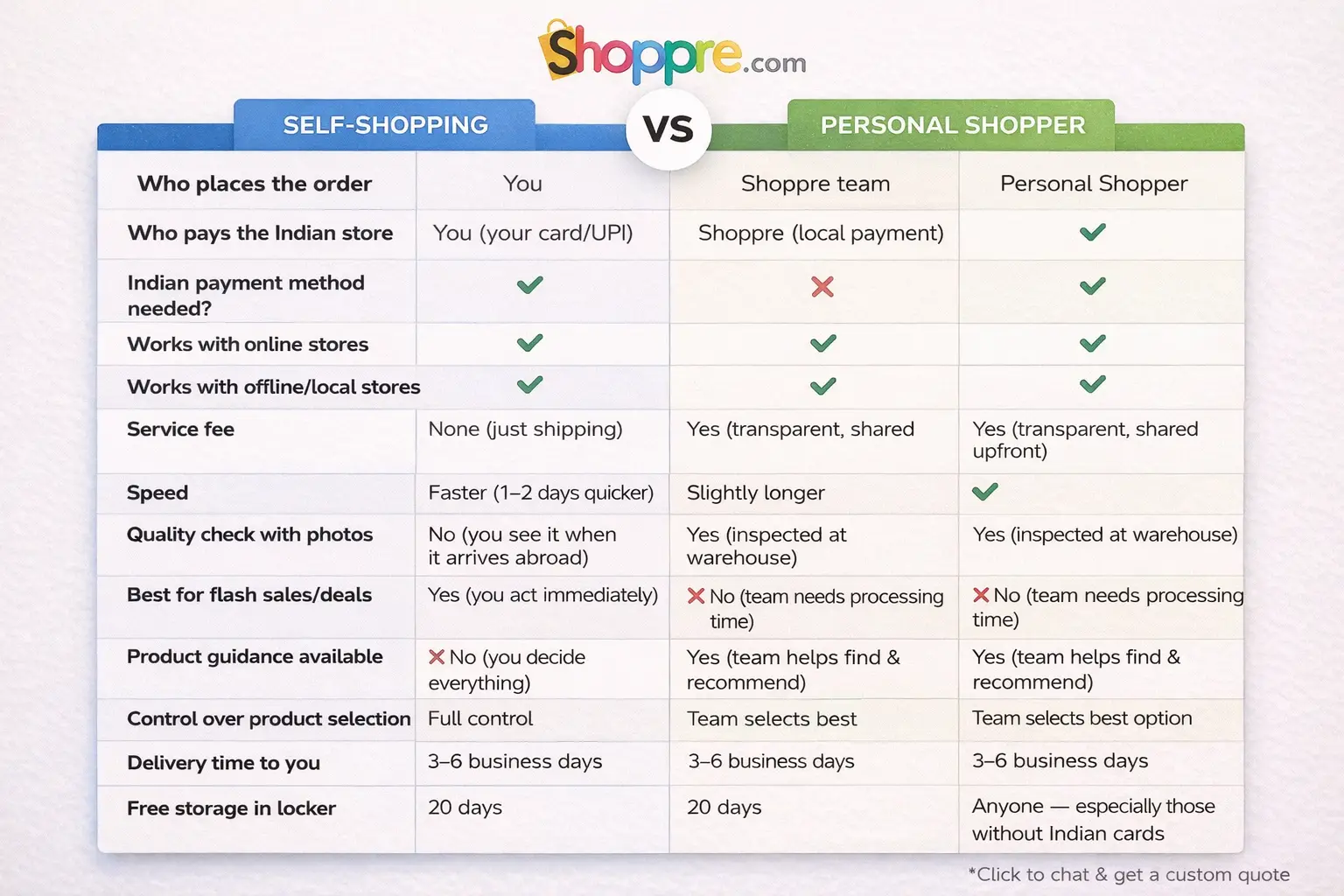
Real Scenarios: Which Should You Pick?
Sometimes the best way to decide is to see yourself in a real situation. Here are 8 common NRI scenarios and the right choice for each:
Scenario 1: "I want to buy a kurta from Myntra during their sale"
→ Self-Shopping. You know the exact product, Myntra has a user-friendly app, and sale prices move fast. Log in, order, and use your Shoppre address. Done in 3 minutes.
Scenario 2: "I want to send Diwali sweets and a silver Lakshmi idol to my mother-in-law in Dubai"
→ Personal Shopper. The sweets might come from a local mithai shop, and the silver idol from a specific jeweller. Neither of these is on Amazon. Personal Shopper will buy both, consolidate, and ship.
Scenario 3: "I live in the USA and my card doesn't work on any Indian website"
→ Personal Shopper. No debate. If you can't pay, you can't Self-Shop. Personal Shopper removes the payment barrier entirely.
Scenario 4: "I need 10 different items from Amazon.in, Flipkart, and Ajio"
→ Self-Shopping (if your card works). You'll get the best prices by ordering directly, grabbing each site's coupons and deals. All packages arrive at your Shoppre locker. Consolidate into one box. Ship.
Scenario 5: "I want to buy my wedding saree from a specific silk store in Kanchipuram"
→ Personal Shopper. An offline store with no website? Only Personal Shopper can handle this. The team can even do a video call while at the store so you can choose the saree yourself.
Scenario 6: "I want to buy baby essentials — silver glass, cradle toys, and an outfit — as a naming ceremony gift"
→ Personal Shopper. Multiple items from potentially different stores (silver from a jeweller, outfit from Myntra, toys from a local shop). The team coordinates everything and ships as one gift package.
Scenario 7: "I order from Amazon India every month and know exactly what I need"
→ Self-Shopping. You're a repeat buyer, your payment works, and you don't need hand-holding. Self-Shopping is faster and cheaper for regular purchases.
Scenario 8: "I saw a beautiful dress on an Instagram seller's page and want to buy it"
→ Personal Shopper. Instagram sellers often don't have proper e-commerce checkout flows. Some only accept UPI or bank transfers. Personal Shopper contacts the seller directly, handles payment, and gets it shipped to the warehouse.
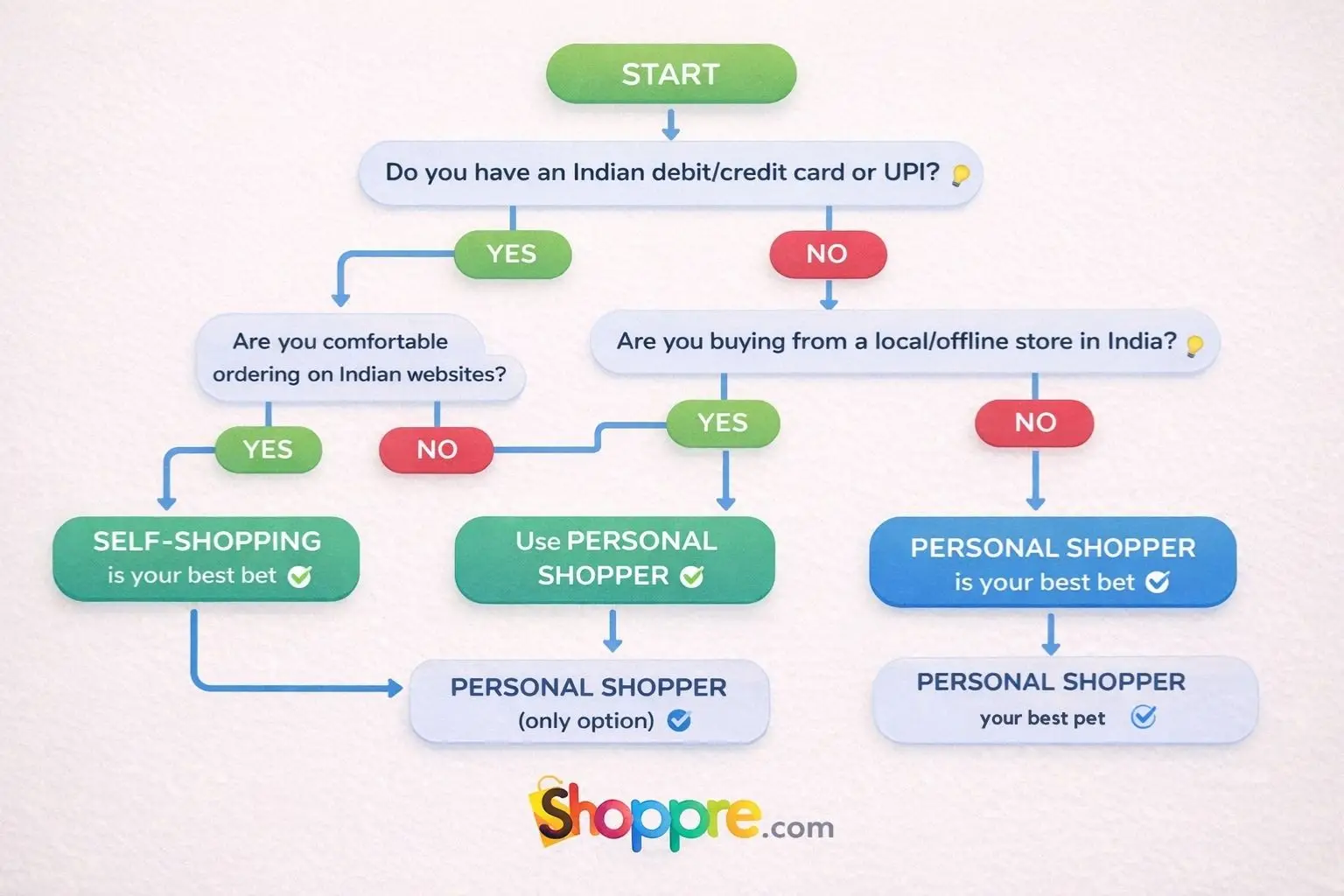
Can You Use Both? Absolutely.
Here's what smart Shoppre users do: they use Self-Shopping for routine online purchases where they know the product and their card works, and they switch to Personal Shopper for tricky, offline, or payment-blocked purchases.
Both services feed into the same Shoppre locker. So if you Self-Shop three items from Amazon and use Personal Shopper for one item from a local jeweller, all four items end up in your locker. Shoppre consolidates everything into one box and ships once. You save on shipping either way.
This hybrid approach is actually the most cost-effective strategy: Self-Shop wherever you can (no service fee), and use Personal Shopper only when you genuinely need it.
Frequently Asked Questions
Q1. Is there a service fee for Self-Shopping on Shoppre? No. With Self-Shopping, you only pay the product price (to the Indian store) and Shoppre's international shipping fee. There's no additional service charge from Shoppre for receiving and storing your package.
Q2. How much does the Personal Shopper service cost? The service fee depends on the order value and is shared with you transparently before you confirm. It covers the effort of placing the order, handling local payment, inspecting the product, and coordinating with the seller. Check Shoppre Personal Shopper page for the latest pricing.
Q3. Can the Personal Shopper buy from any store in India? Almost any. The team can purchase from major e-commerce sites (Amazon, Flipkart, Myntra, Ajio, Nykaa, Meesho), smaller online stores, Instagram/Facebook sellers, and even local offline shops and markets. The only exception is stores or products on Shoppre prohibited items list.
Q4. What if my Self-Shopping order arrives damaged at Shoppre warehouse? Shoppre team will notify you. Since you placed the order directly with the store, you'd need to coordinate a return or replacement through that store's return policy. The advantage of Personal Shopper is that the team handles this for you.
Q5. Can I use both services at the same time? Yes, and this is actually recommended. Self-Shop where you can, use Personal Shopper where you need it. All items go into the same locker and can be consolidated into one shipment.
Q6. Which is faster — Self-Shopping or Personal Shopper? Self-Shopping is typically 1–2 days faster because there's no order processing queue. You place the order directly, and the store ships immediately. With Personal Shopper, the team needs a short window to review, confirm, and place the order.
Q7. I don't have any Indian payment method. Can I still use Shoppre? Absolutely. That's exactly what Personal Shopper is designed for. You pay Shoppre in your preferred currency (PayPal, international card), and the team uses local Indian payment methods to place the order. No Indian card, UPI, or bank account needed.
The Bottom Line
Self-Shopping is for control. You want to drive the car yourself.
Personal Shopper is for convenience. You want someone else to drive while you sit back.
Neither is "better" — they serve different moments. The NRI who orders protein powder from Amazon India every month doesn't need a Personal Shopper. The same NRI who wants to surprise her parents with a custom silver photo frame from a Jaipur jeweller absolutely does.
The smartest approach? Use both. Let the situation decide, not the habit.