
Managing Time Zone Differences Between India and Canada
Published on 14th April 2026 by Vismaya R K
General

A Complete NRI Guide for Indians Living in Canada
Living between India and Canada means constantly living on two clocks. Whether you are working with Indian clients, attending early morning calls, or simply trying to reach your parents on a Sunday evening, the time zone gap between IST and Canadian time zones can quietly disrupt your productivity, sleep, and relationships.
For Indians living in Canada, life often runs on two very different rhythms. Your workday follows Canadian hours, while your heart stays connected to family, festivals, and routines back in India.
Whether it is a late-night video call, coordinating a shipment from India, or finding the right time to chat with loved ones, managing the India–Canada time difference becomes a very real part of everyday NRI life.
This guide helps NRIs understand how the India–Canada time difference works, the common challenges Indians face, and practical strategies to manage it without burning out.
Understanding the Time Difference Between India and Canada
India follows Indian Standard Time (IST), which is UTC +5:30. India does not observe Daylight Saving Time. Canada, however, spans six time zones and follows Daylight Saving Time (DST) making the gap between IST and Canadian time zones different depending on where in Canada you live and the time of year.
Major Canadian Time Zones Compared to India
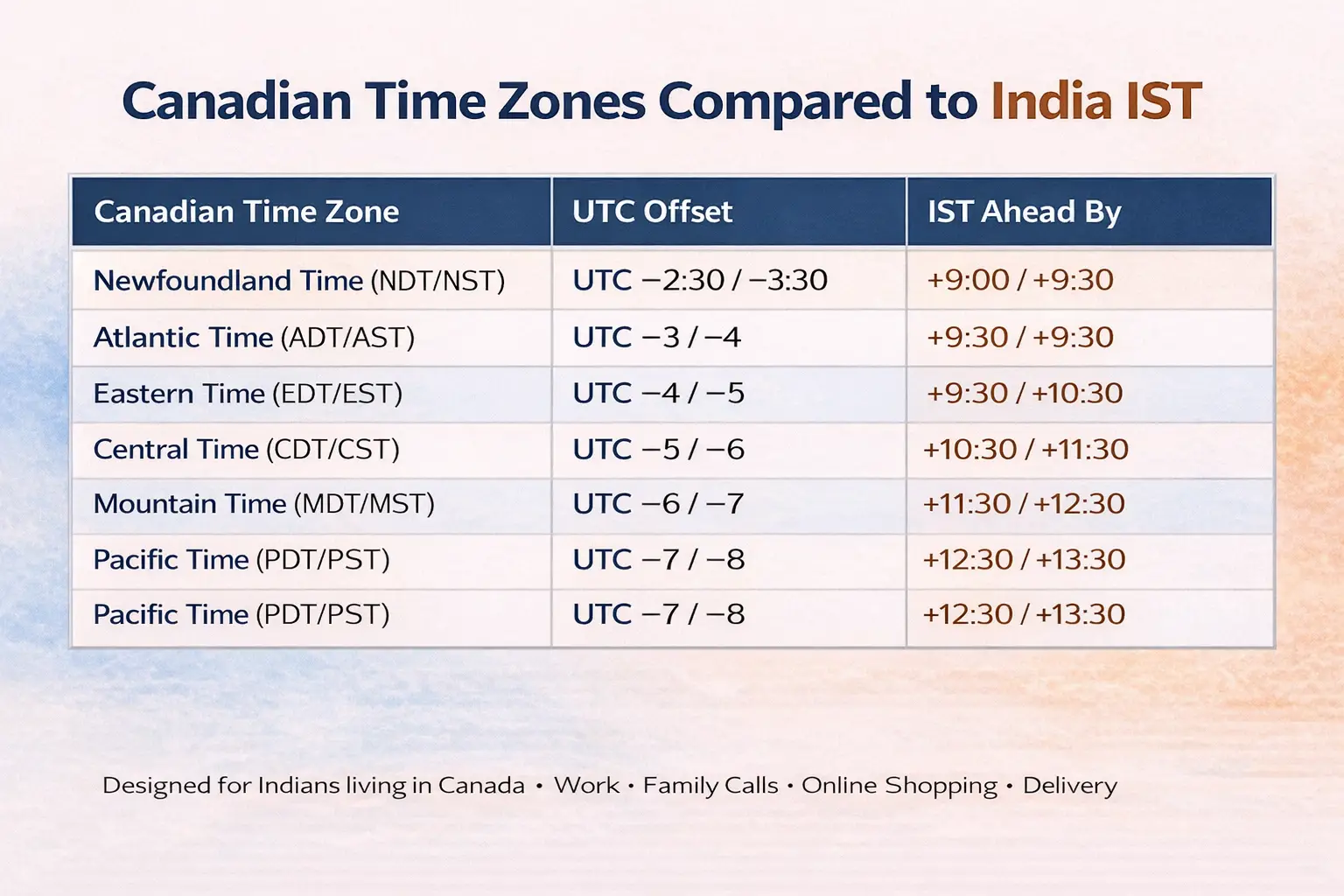
an Time ZoneUTC Offset
Note: The first offset in each row is during Daylight Saving Time (DST, summer months), and the second is Standard Time (winter months). Newfoundland has a rare 30-minute offset, making it unique even among Canadian provinces.
Why this matters: A 9 AM workday in Toronto or Vancouver can mean late evening or even early next morning in India, depending on the season.
Why Managing Time Zones Is Challenging for Indians in Canada
Time zone gaps are not just inconvenient they affect daily life in subtle but significant ways for NRIs.
Common challenges include:
• Early morning or late-night calls with family in India
• Limited overlap hours for professional communication across countries
• Difficulty coordinating shipments, orders, or delivery updates from India
• Sleep disruption and fatigue from irregular call timings
• Missing live events, pujas, or family celebrations due to odd hours
• Blurred boundaries between work and personal time
For NRIs, students, and remote professionals working across India and Canada, this becomes a long-term lifestyle challenge rather than a one-time adjustment.
Best Strategies to Manage India–Canada Time Differences
Fix a 'Common Overlap Window'
Instead of staying available across all hours:
• Identify 1–3 overlapping hours that work for both sides
• Keep meetings and calls within that window as much as possible
• Communicate these hours clearly to teams, clients, and family
For example, 8–9 PM IST roughly aligns with 8:30–9:30 AM EDT (Toronto summer) — a practical overlap for working professionals.
Use Time Zone Tools — Not Mental Math
Relying on memory leads to mistakes, especially when DST shifts change the gap by an hour.
Recommended tools:
• World Clock app on your phone
• Google Calendar with dual time zones enabled
• TimeandDate.com for quick conversions
• Calendly or scheduling tools that auto-convert time zones
Pro tip: Always label your calendar events as IST or EDT/EST/PDT/PST explicitly to avoid confusion across seasons.
Plan Calls with Family in Advance
For personal connections back home:
• Fix recurring call times — for example, Sunday evenings in Canada / Sunday night in India
• Share your weekly availability with parents clearly
• Avoid spontaneous calls that disrupt sleep or work on either side
Consistency helps both sides adjust emotionally and practically over time.
Protect Your Sleep and Health
Long-term late nights or early mornings to accommodate India timing can cause burnout, poor focus, and weakened immunity.
Healthy habits to adopt:
• Avoid back-to-back late-night calls on weekdays
• Use blue-light filters after 9 PM
• Schedule a recovery morning after calls run late
• Batch all India-related calls or tasks into one or two time slots per week
Managing Time Zones for Work, Studies, and Business
For Working Professionals
• Batch India-related meetings on specific days of the week
• Push non-urgent discussions to email or async tools like Slack or Loom
• Set calendar blocks for deep work and protected rest time
• Use shared project management tools to reduce real-time dependency
For Students and Online Learners
• Convert all deadlines to your local Canadian time immediately when assigned
• Set reminders 24 hours before any submission or live session
• Avoid last-minute uploads that could fall across time zone boundaries
• Confirm exam times with institution in local time
For Freelancers and Business Owners
• Clearly state your working hours in both IST and your Canadian time zone
• Use service-level agreements (SLAs) instead of promising instant replies
• Build buffer time for approvals, revisions, and document sign-offs across time zones
• Consider hiring a local point of contact in India for real-time support
Daylight Saving Time: Canada's Hidden Complication
Unlike the USA which has one DST shift, Canada's six time zones each observe DST at the same time — but provinces like Saskatchewan do not observe DST at all. This means the gap between IST and Canadian time can change significantly depending on the province and the season.
What you should watch for:
• Canada moves clocks forward in March and back in November
• Saskatchewan stays on CST year-round (no DST), making it easier to schedule with India
• The IST–Canada gap can fluctuate by 1 hour at DST transitions
• Many missed calls and meetings happen in the week after a DST change
What you should do:
• Double-check meeting times every March and November
• Update recurring calendar events after DST transitions
• Confirm scheduling with family and clients during transition weeks
• If you are in Saskatchewan or the NWT, communicate that clearly to India contacts
Emotional Side of Living Between Two Time Zones
Beyond logistics, the time difference between India and Canada has a real emotional cost for NRIs.
• Feeling disconnected from important family milestones
• Missing real-time celebrations — Diwali, weddings, births — at odd hours
• The guilt of not being available when family calls
• Adjusting to conversations happening in the middle of your night
Acknowledging this emotional load helps reduce guilt and stress. Planned, consistent communication is far better — and more sustainable — than constant availability across all hours.
Smart Ways NRIs Manage India–Canada Time Differences
• Set fixed communication windows: NRIs who stay well-connected usually fix weekly or daily time slots for work calls, family chats, and personal planning — and protect those windows.
• Use scheduling tools instead of guessing: Automatic time conversion tools help avoid missed calls, delayed deliveries, and coordination errors — especially when Canadian clocks shift with DST.
• Plan recovery time after late nights: When calls run late, successful NRIs plan lighter mornings or flexible schedules to maintain balance and energy.
Time Zones and Shopping from India
When shopping from Indian websites or managing shipments with services like Shoppre:
• Order confirmations, warehouse pickups, and customs updates all follow Indian working hours (IST)
• Planning ahead avoids delays caused by missed communication across time zones
• Understanding the IST offset helps NRIs in Canada track shipments more confidently
• Festive season orders — Diwali, Holi, Raksha Bandhan — benefit from early planning to account for the time gap
This is especially important when consolidating multiple packages or coordinating gift deliveries from India to Canada.
Also planning calls with family or tracking shipments from the US? Check out our guide on the India–USA time difference to see how it compares province to province.
Final Thoughts for NRIs in Canada
Time zones do not have to divide your life, they just need better management.
Managing the time difference between India and Canada is less about calculating hours and more about setting boundaries, using the right tools, and creating routines that work for both sides.
Whether you are in Vancouver on Pacific Time, Toronto on Eastern, or Winnipeg on Central, the distance from India is the same but with the right habits and tools, staying connected is completely within reach.
With clear communication and smart scheduling, it is possible to stay productive, connected, and healthy — without living permanently on two clocks.
People Also Ask: India–Canada Time Zone
What is the time difference between India and Canada?
India (IST) is generally 9.5 to 13.5 hours ahead of Canada, depending on the Canadian time zone and whether Daylight Saving Time is in effect. Eastern Canada has the smallest gap; Pacific Canada has the largest.
Why does the India–Canada time difference change during the year?
Canada observes Daylight Saving Time (except Saskatchewan), while India does not. This causes the gap between IST and Canadian time to shift by one hour in spring (March) and fall (November).
What is the best time to call India from Canada?
Early mornings in Canada (7–9 AM local time) align well with evenings in India (IST 6:30–9:30 PM depending on your province), making this the most practical window for family and work calls.
Does Saskatchewan follow the same time zone rules as other Canadian provinces?
No. Saskatchewan observes Central Standard Time (CST) year-round and does not observe Daylight Saving Time. This makes scheduling with India more predictable — IST is always 11.5 hours ahead of Saskatchewan.
How can NRIs in Canada avoid sleep disruption from late-night calls to India?
By fixing specific call days, limiting late-night meetings to 1–2 per week, using calendar blocks for protected rest, and avoiding constant availability at all hours.
Which tools help manage the India–Canada time difference?
Google Calendar with dual time zones enabled, World Clock apps, and scheduling tools like Calendly all help prevent confusion and missed calls across time zones.
Why do time zones matter more for NRIs in Canada than other countries?
Canada spans 6 time zones, all of which observe DST (except Saskatchewan). Combined with India's fixed IST offset and no DST, the gap changes twice a year and varies widely by province making consistent scheduling more challenging than in countries with fewer time zones.