
International Air Freight Volumetric Weight Guide: Formula, Examples & Cost Calculations
Published on 2nd June 2026 by Vismaya R K
Shipping
What Is Volumetric Weight in International Air Freight?
When shipping packages internationally by air, carriers don't always charge based solely on the actual weight of a parcel. Instead, they often use a pricing method called volumetric weight, also known as dimensional weight.
Volumetric weight reflects the amount of space a package occupies inside an aircraft. Large but lightweight packages can take up valuable cargo space, so airlines and courier companies use volumetric weight calculations to determine fair shipping charges.
Understanding how to calculate volumetric weight for international air freight can help businesses and online shoppers estimate shipping costs accurately and avoid unexpected charges.
🚚 Need an instant shipping estimate?
Use our Free International Shipping Rates Estimation Tool to compare shipping costs to 180+ countries worldwide before calculating your volumetric weight.
Quick Answer: How Do You Calculate Volumetric Weight?
The standard air freight formula is:
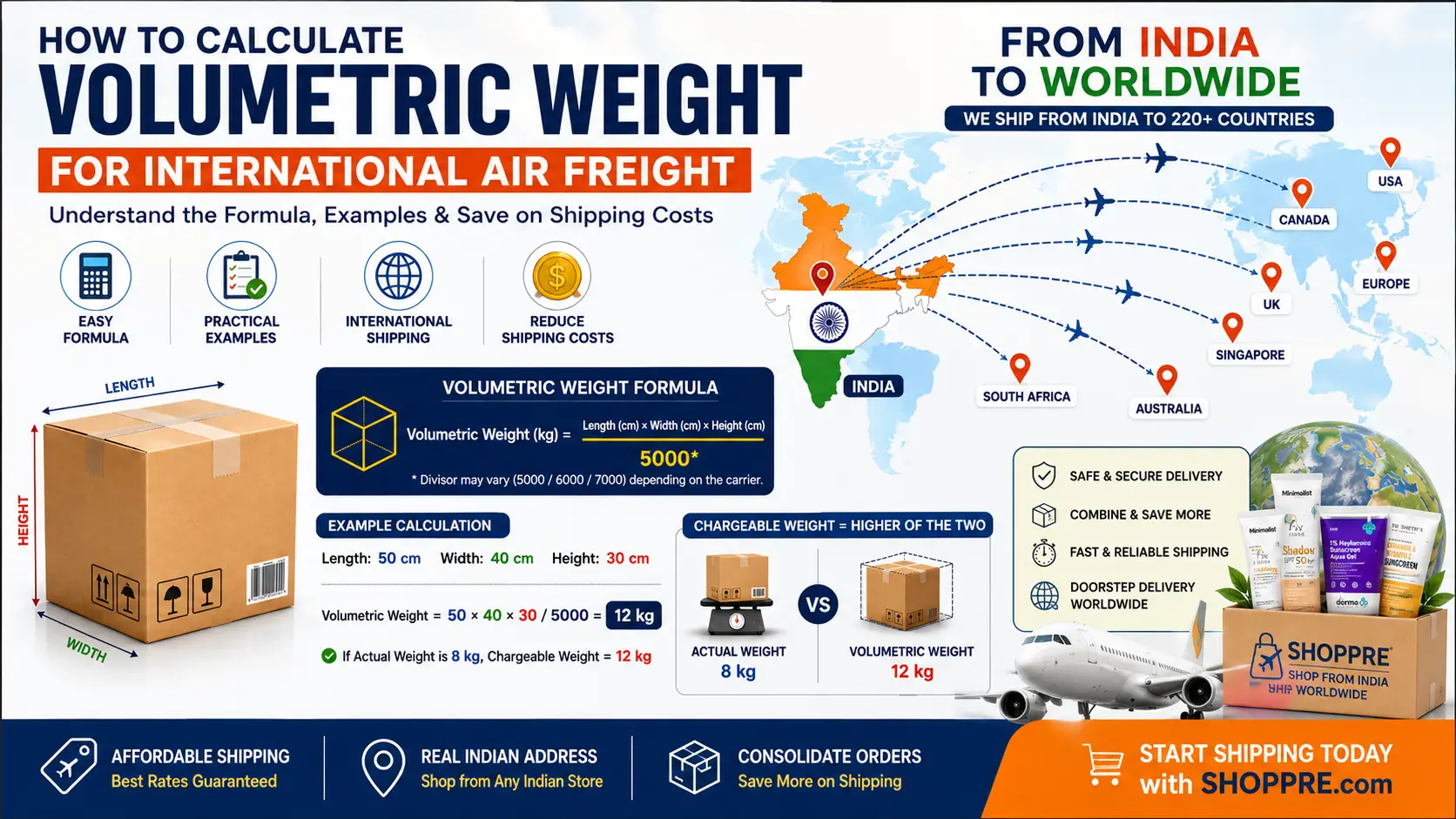
Volumetric Weight = Length × Width × Height ÷ 5000
Where:
Length = package length in centimeters
Width = package width in centimeters
Height = package height in centimeters
Divisor = 5000 (commonly used by many airlines and couriers)
Example
Suppose your package dimensions are:
Length: 50 cm
Width: 40 cm
Height: 30 cm
Calculation:
Volumetric Weight = (50 × 40 × 30) ÷ 5000
Volumetric Weight = 60,000 ÷ 5000
Volumetric Weight = 12 kg
Even if the package actually weighs 8 kg, the carrier may charge based on 12 kg because the package occupies more cargo space.
Why Do Airlines Use Volumetric Weight?
Aircraft cargo space is limited. A lightweight but oversized package can occupy the same space as several smaller packages.
To maximize efficiency, airlines calculate both:
Actual Weight
The physical weight of the shipment.
Volumetric Weight
The space occupied by the shipment.
The higher value becomes the chargeable weight.
This ensures fair pricing for all shipments and helps airlines optimize cargo capacity.
What Is Chargeable Weight?
Chargeable weight is the weight used to calculate shipping charges.
Carriers compare:
Actual Weight
Volumetric Weight
The higher value becomes the chargeable weight.
Example
Measurement and Weight
Actual Weight: 10 kg
Volumetric Weight: 14 kg
Chargeable Weight: 14 kg
In this case, shipping charges are calculated using 14 kg.
Step-by-Step Guide to Calculating Volumetric Weight
Step 1: Measure Package Length
Measure the longest side of the package in centimeters.
Step 2: Measure Package Width
Measure the shorter side across the package.
Step 3: Measure Package Height
Measure from the base to the highest point.
Step 4: Multiply Dimensions
Length × Width × Height
Step 5: Divide by the Carrier's Divisor
Most international air freight providers use:
5000
6000
7000 (less common)
Always confirm with your shipping provider.
Volumetric Weight Calculation Examples
Example 1: Small Parcel
Dimensions:
30 cm × 20 cm × 15 cm
Calculation:
30 × 20 × 15 = 9,000
9,000 ÷ 5000 = 1.8 kg
Volumetric Weight = 1.8 kg
Example 2: Medium Package
Dimensions:
60 cm × 40 cm × 35 cm
Calculation:
60 × 40 × 35 = 84,000
84,000 ÷ 5000 = 16.8 kg
Volumetric Weight = 16.8 kg
Example 3: Large Lightweight Box
Dimensions:
100 cm × 60 cm × 50 cm
Calculation:
100 × 60 × 50 = 300,000
300,000 ÷ 5000 = 60 kg
Volumetric Weight = 60 kg
Even if the actual weight is only 20 kg, the carrier may charge based on 60 kg.
Common Volumetric Weight Divisors Used by Carriers
Different logistics companies may use different conversion factors.
Carrier Type and Common Divisor
Air Freight: 5000
Express Courier: 5000–6000
International Logistics Providers: 5000–7000
Before shipping internationally, always verify the divisor used by your chosen carrier.
Volumetric Weight vs Actual Weight
Many people confuse actual weight with volumetric weight.
Actual Weight
The physical weight measured on a scale.
Volumetric Weight
Theoretical weight based on package dimensions.
Which One Matters?
The higher value determines shipping costs.
For example:
Weight Type and Result
Actual Weight: 15 kg
Volumetric Weight: 22 kg
Chargeable Weight: 22 kg
How Volumetric Weight Affects International Shipping Costs
Volumetric weight can significantly impact shipping expenses, especially for:
Clothing shipments
Footwear shipments
Household items
Lightweight consumer goods
E-commerce orders
Businesses shipping internationally should calculate volumetric weight before placing orders to estimate total logistics costs accurately.
Tips to Reduce Volumetric Weight
Use Smaller Packaging
Avoid oversized boxes whenever possible.
Eliminate Empty Space
Fill unnecessary gaps efficiently.
Consolidate Shipments
Combining multiple packages into one shipment can reduce overall shipping expenses.
Choose Packaging Wisely
Custom-sized boxes often help reduce dimensional weight charges.
Work with Experienced Freight Forwarders
Professional logistics providers can optimize packaging and shipping strategies.
How Package Consolidation Helps Lower Shipping Costs
Package consolidation combines multiple purchases into one shipment.
Benefits include:
Reduced volumetric weight
Lower shipping charges
Fewer handling fees
Improved shipping efficiency
For international shoppers purchasing from multiple online stores, consolidation can result in significant savings.
Frequently Asked Questions
What is volumetric weight in air freight?
Volumetric weight is a pricing method that calculates shipping charges based on package dimensions rather than actual weight.
What is the formula for volumetric weight?
The most common formula is:
Length × Width × Height ÷ 5000
using dimensions measured in centimeters.
Why is volumetric weight important?
It ensures carriers charge fairly for large packages that occupy significant cargo space.
What is chargeable weight?
Chargeable weight is the higher value between actual weight and volumetric weight.
Do all carriers use the same divisor?
No. Different airlines and courier companies may use divisors such as 5000, 6000, or 7000.
How can I reduce volumetric weight?
Use compact packaging, eliminate empty space, and consolidate shipments when possible.
Does volumetric weight apply to international courier services?
Yes. Most international courier providers use dimensional or volumetric weight calculations for air shipments.
Conclusion
Understanding how to calculate volumetric weight for international air freight is essential for businesses, online sellers, and international shoppers. Since air carriers charge based on either actual weight or dimensional weight, whichever is greater knowing how to perform this calculation helps you estimate shipping costs accurately and avoid surprises.
By measuring your package correctly, applying the appropriate formula, and optimizing packaging whenever possible, you can reduce shipping expenses and make smarter international shipping decisions.